
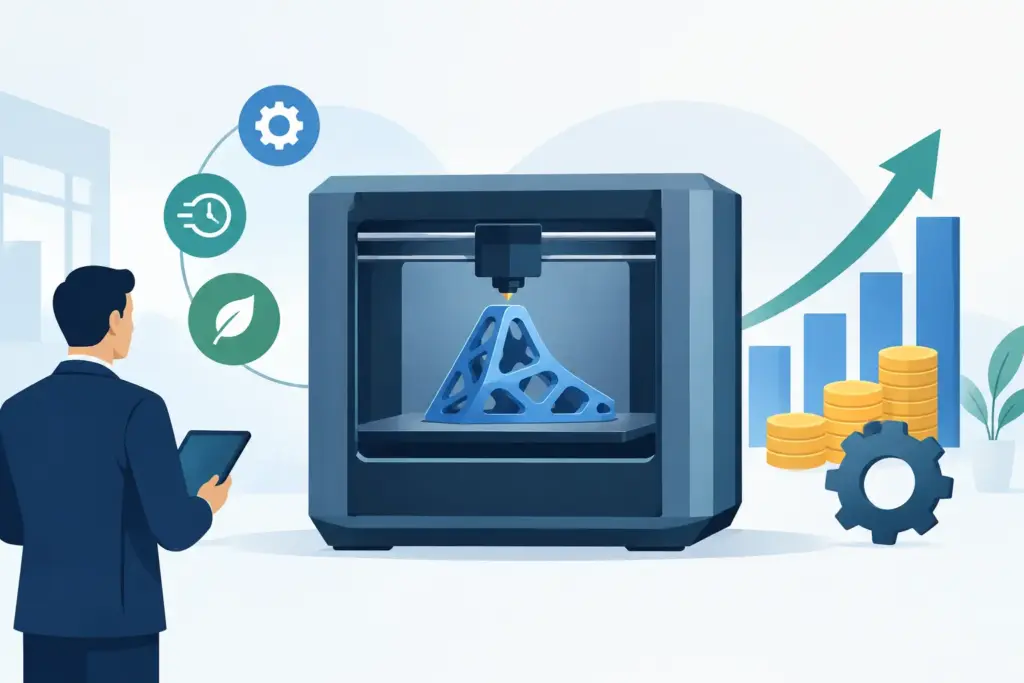
A printed metal bracket is not a business model. For industrial leaders, the central question in additive manufacturing is not whether a part can be produced layer by layer. It is whether that capability can improve margin, shorten a qualified supply chain, protect intellectual property, reduce working capital, or create a defensible position in a high-value market.
That distinction separates technology demonstrations from durable enterprises. Additive has earned a meaningful role in aerospace, medical, energy, defense, and advanced industrial applications because it can solve problems conventional processes cannot solve economically or quickly. But the path from compelling geometry to recurring revenue is demanding. It requires technical rigor, commercial discipline, and a capital strategy that matches the realities of qualification and scale.
Additive Manufacturing Is a Strategic Capability, Not a Standalone Strategy
The strongest additive manufacturing businesses begin with an industrial problem that has measurable economic consequences. It may be a long lead-time casting, a high-cost assembly that can be consolidated into one part, an obsolete component with insufficient volume for traditional tooling, or a thermal-management challenge that limits system performance.
In each case, the advantage is not simply that the part is printed. The advantage is a better total solution. A redesigned component may reduce weight, eliminate fasteners, improve flow characteristics, lower inventory exposure, or reduce the number of suppliers required to support a program. Those benefits are especially valuable in capital-intensive industries where downtime, qualification delays, and supply-chain disruption can carry far greater costs than the piece price of a single component.
Boards and investors should be cautious when the investment thesis rests on broad claims that additive will replace conventional manufacturing. It will not replace machining, forging, casting, molding, or fabrication across most production volumes. Conventional processes remain highly efficient when geometry is stable, volume is high, and tooling economics are favorable. Additive wins where complexity, performance, responsiveness, or supply-chain resilience outweigh the cost of the build.
Where Additive Manufacturing Creates Real Value
The most attractive opportunities usually sit at the intersection of engineering complexity and commercial urgency. Aerospace provides a clear example. Weight reduction, part consolidation, material performance, and traceability are central to program economics. A component that costs more to produce may still create significant value if it lowers fuel consumption, extends service life, or removes failure points from a critical assembly.
The same logic applies in industrial equipment and energy systems. Internal channels, conformal cooling, low-volume service parts, and rapid design iterations can justify additive approaches that would be uneconomic through traditional tooling. For legacy equipment fleets, digital inventories can also reduce the carrying cost and obsolescence risk associated with physical spare-parts stock.
The opportunity is often strongest in four situations:
- A part is expensive because it requires multiple manufacturing steps, assemblies, or specialized tooling.
- A customer has a material-performance, thermal, weight, or reliability requirement that conventional geometry cannot address.
- Demand is too low or volatile to support dedicated tooling and inventory economics.
- Supply-chain risk has become material to customer operations, program schedules, or revenue.
These conditions do not guarantee a successful program. They do, however, create a rational basis for paying for performance rather than merely comparing machine-hour costs.
Design Is the First Economic Decision
A common error is treating additive as a substitute production route for a legacy design. The better approach is design for additive manufacturing. That means reconsidering the part architecture, the number of interfaces, material placement, post-processing needs, inspection requirements, and service environment.
If an organization prints a conventionally designed component without redesigning it, the result may be a more expensive version of the same part. When engineering teams use additive to consolidate assemblies, remove unnecessary material, integrate functions, or improve thermal performance, the economics can shift substantially.
This is where experienced leadership matters. Engineering decisions determine not only manufacturability but also qualification cost, yield, cycle time, and future margin. The technical team and commercial team must be aligned early, before a customer is promised a price or delivery schedule that ignores the realities of industrialization.
Qualification Is the Moat and the Constraint
In regulated and performance-critical markets, qualification is not an administrative hurdle. It is part of the product. Process parameters, powder handling, machine calibration, post-processing, heat treatment, nondestructive testing, and documentation all influence the final component’s properties.
For aerospace and defense applications, the qualification cycle can be long and capital-intensive. That can frustrate investors seeking rapid revenue expansion, but it can also create a meaningful barrier to entry once a supplier is embedded in an approved program. The enterprise value lies in the combination of customer trust, qualified process knowledge, production data, and a repeatable quality system.
Companies should resist the temptation to pursue every possible certification at once. A disciplined market-entry plan identifies the initial application, the specific quality requirements, the customer decision-maker, and the evidence needed to secure adoption. Certification without an anchored commercial program can become an expensive overhead structure rather than a growth asset.
Repeatability Matters More Than a Showcase Part
Trade-show components can demonstrate remarkable geometries. Investors and customers ultimately need evidence of repeatability. Can the company produce consistent material properties across builds, machines, facilities, and production lots? Can it document traceability and manage deviations? Can it meet delivery commitments while preserving margin?
Those questions move the conversation from innovation to operations. A capable production system requires disciplined powder management, validated post-processing, clear work instructions, inspection capacity, preventive maintenance, and quality leadership with authority to stop a shipment when the data is not acceptable.
For a board, the leading indicators are not only bookings and installed machine count. They include yield, scrap, rework, machine utilization, throughput, on-time delivery, customer qualification milestones, and the cost of quality. A growing backlog can conceal a weak operating model if process capability is not advancing alongside demand.
The Unit Economics Must Include the Entire Process
Too many financial models compare the cost of printing a part with the cost of machining or casting it. That comparison is incomplete. The true cost includes design engineering, build preparation, material, machine depreciation, labor, support removal, heat treatment, hot isostatic pressing where required, machining, inspection, certification, packaging, and warranty exposure.
Post-processing is frequently the overlooked variable. In many metal applications, it represents a substantial share of final part cost and a meaningful source of capacity constraints. A company that owns only the printing step may be exposed if external finishing partners become the bottleneck. Conversely, bringing every process in-house too early can burden the balance sheet and reduce flexibility.
The correct answer depends on customer requirements, volume visibility, available capital, and the strategic importance of process control. The objective is not vertical integration for its own sake. It is control over the critical path, dependable quality, and an economic model that improves as volume matures.
Capital Allocation Should Follow Commercial Proof
Additive manufacturing can be capital intensive, particularly when a company acquires premium equipment before securing recurring programs. Machine purchases are easy to explain as growth investments. Their returns, however, depend on qualified utilization, not theoretical capacity.
A stronger approach stages capital against evidence. First, validate the customer problem and application economics. Next, establish repeatable production through internal capability, qualified partners, or both. Then add capacity as program awards, utilization, and margin visibility justify it. This approach protects shareholder capital while preserving the ability to scale quickly when demand becomes real.
Leaders should also distinguish between revenue that proves demand and revenue that creates enterprise value. One-time development work can build relationships and fund learning, but recurring production programs, aftermarket demand, proprietary designs, and qualified process data generally support a more durable valuation. The commercial model should show how development work converts into long-term production, licensing, service, or digital-inventory revenue.
What Boards Should Ask Before Committing Capital
The board-level discussion should be precise. Which applications have a clear cost or performance advantage? What is the qualification pathway and who pays for it? Where does margin improve with scale, and where does it deteriorate because of finishing, inspection, or low yield? Which capabilities are truly proprietary, and which are readily available from competitors?
Equally important, management should articulate the customer concentration and program-risk profile. A single large aerospace award can transform a company’s trajectory, but it can also create exposure to lengthy approval cycles, production-rate changes, and delayed cash conversion. A balanced portfolio of development, production, and aftermarket opportunities is often more resilient than dependence on one flagship program.
Hasit Vibhakar’s experience across advanced manufacturing and engineered products reflects a practical principle: technical differentiation becomes enterprise value only when it is connected to execution, capital discipline, and a credible route to commercialization.
The winners in additive will not necessarily be the organizations with the most machines or the most dramatic prototypes. They will be the companies that select the right applications, qualify relentlessly, price for the value they create, and build operating systems worthy of the markets they intend to serve.
About Hasit Vibhakar. Hasit Vibhakar is a serial entrepreneur, founder and CEO with over 25 years of experience building, scaling, & increasing shareholder value across diversified sectors. Hasit Vibhakar is open to Board Advisory roles to mentor, guide and share his knowledge with new entrepreneurs and ventures. @hasitvibhakar Hasit Vibhakar Official Website is www.hasitvibhakar.m