
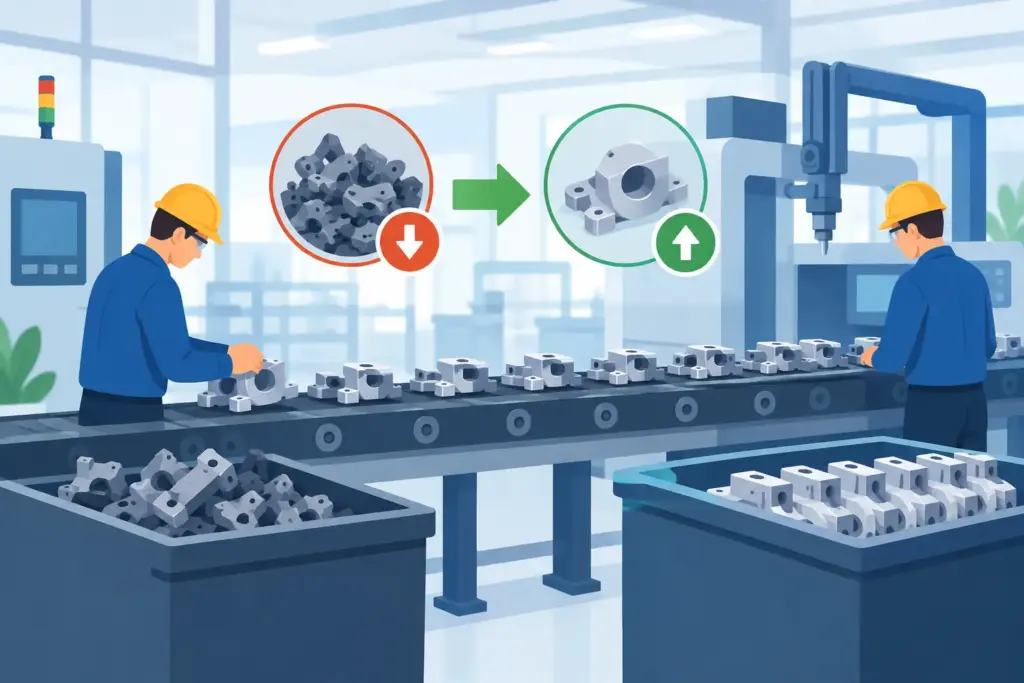
Scrap is not simply a shop-floor nuisance. It is purchased material, machine time, labor, energy, capacity, and schedule reliability that have already been consumed without producing revenue. Leaders asking how to reduce factory scrap should treat it as an operating-system question, not a cleanup exercise assigned to quality after the loss has occurred.
For capital-intensive manufacturers, even a modest reduction in scrap can create an outsized improvement in gross margin and free cash flow. The effect is particularly meaningful in aerospace, semiconductor-adjacent production, engineered products, casting, forging, and other environments where material value, qualification requirements, and lead times are substantial. The objective is not to pressure teams to report lower numbers. It is to build processes that prevent defects, expose variation early, and turn production data into better commercial decisions.
Start With the True Cost of Scrap
The accounting entry for scrap rarely captures its full economic cost. A rejected part may carry direct material and labor, but it can also trigger expedited freight, added inspection, tooling wear, line disruption, warranty exposure, delayed shipment, and lost capacity for profitable work. When a constrained machine produces scrap, the opportunity cost may be greater than the recorded cost of the component itself.
Management should therefore establish a consistent definition of scrap and separate it from rework, yield loss, supplier defect, and customer return. These categories are connected, but they demand different corrective actions. Rework may be economically rational for a high-value component with an approved repair route. Repeated rework, however, can conceal an unstable process and distort the apparent cost of quality.
A useful executive measure is scrap cost as a percentage of conversion value or sales, reported by product family, production cell, shift, customer program, and defect code. Pair it with first-pass yield, overall equipment effectiveness, on-time delivery, and cost of poor quality. This prevents a narrow improvement in scrap from coming at the expense of throughput, delivery performance, or inspection cost.
How to Reduce Factory Scrap by Finding the Vital Few Causes
Most factories do not lack data. They lack a disciplined way to distinguish meaningful signals from the daily volume of production records. A Pareto analysis is still one of the most effective starting points: identify the few defect modes, part numbers, suppliers, tools, or operations responsible for the majority of scrap cost.
Do not stop at counting defective pieces. Rank losses by dollars, frequency, risk to the customer, and effect on constrained capacity. A cosmetic flaw on a low-value part may be frequent but economically secondary. A dimensional failure on an aerospace component, by contrast, may occur less often while consuming significant material, engineering attention, and delivery margin.
Once the priority defect is clear, follow the part through the actual process. Review material certificates, incoming inspection, machine parameters, fixture condition, operator instructions, tool life, environmental conditions, inspection records, and maintenance history. The discussion should occur at the point of work with operators, engineers, quality personnel, and maintenance leaders present. The people closest to the operation often know where variation begins, even if the formal data system does not yet show it.
Root-cause analysis must go beyond the final failed dimension or visible defect. Asking why five times can be useful, but only when supported by evidence. If a bore is out of tolerance, the cause may be tool wear. The reason for the tool wear may be an incorrect material condition, an unstable coolant concentration, an undocumented parameter change, or a purchasing decision that altered tool specification. Corrective action should address the process condition that created the failure, not merely the last symptom recorded on a nonconformance report.
Build Quality Into the Process, Not the Inspection Room
Inspection is necessary in regulated and high-reliability industries, but inspection alone does not create quality. It finds defects after value has been added. The stronger economic model is to prevent the defect or detect it at the earliest practical stage, before additional material and labor are committed.
For recurring operations, use documented standard work with clear setup requirements, visual references where appropriate, verified first-piece approval, and defined escalation points. Digital work instructions can be valuable when they make the correct method easier to follow, but technology should not be deployed as a substitute for sound process engineering.
Statistical process control is particularly effective when applied to characteristics that are both critical and capable of being measured in time to act. Control charts should lead to a specific operating response: adjust the process, inspect a defined sample, replace a tool, or pause production for engineering review. Collecting measurements without a reaction plan creates data, not control.
Poka-yoke, or error-proofing, is often underused because it is mistaken for a simple fixture improvement. Its real value is in removing reliance on memory and judgment for predictable failure modes. A fixture that prevents reversed orientation, a barcode that confirms the correct program revision, or a sensor that verifies component presence can eliminate defects that training alone will not permanently solve.
There is a trade-off. Excessive controls can slow cycle time and create operator frustration. The right approach is proportional to risk, defect cost, and process capability. Add controls where they eliminate material exposure or customer risk, then remove redundant checks once the process has demonstrated sustained stability.
Stabilize Inputs Before Chasing Internal Variation
A factory cannot manufacture consistent output from inconsistent inputs. Supplier quality, incoming material variation, packaging damage, and incomplete documentation are common contributors to internal scrap, especially when purchasing decisions focus narrowly on unit price.
Measure supplier performance by defect cost, responsiveness, lot-to-lot consistency, lead-time reliability, and the burden placed on receiving and production teams. If a supplier-caused issue reaches the production floor, the cost is no longer confined to the purchase order. It affects labor utilization, machine availability, customer commitments, and management attention.
The answer is not always to add more incoming inspection. For critical materials and components, work with strategic suppliers on capability studies, specifications, change-control discipline, and shared corrective actions. For low-risk commodities, broader sampling or supplier certification may be more economical. Segmentation matters. A blanket policy wastes resources and can still miss the few inputs that create the largest losses.
Engineering changes deserve similar rigor. Uncontrolled revision changes, substitute materials, updated tooling, and revised programs can introduce scrap faster than most monthly dashboards can reveal it. Establish a formal launch plan for changes that includes validation builds, accountable signoff, operator communication, and enhanced monitoring during the first production runs.
Make Ownership Visible at Every Level
Scrap reduction fails when it is framed as the quality department’s metric. Quality can lead the system, but production, engineering, supply chain, maintenance, finance, and commercial leadership each influence the result. The plant manager owns the operating cadence. Engineering owns process capability and design-for-manufacturability decisions. Procurement owns supplier selection and specifications. Finance ensures that the organization sees the full economic impact.
Daily tier meetings should review meaningful exceptions, not recite every defect recorded. Teams need rapid containment for active problems, a named owner for corrective action, due dates, and evidence that the fix has been verified across shifts and product families. A corrective action is not complete because a report has been closed. It is complete when the process has remained capable under normal operating conditions.
Leadership behavior matters. If operators believe reporting a defect will invite blame, scrap will be hidden, reworked informally, or discovered by the customer. A disciplined culture distinguishes accountability from blame. The standard should be clear: stop the process when necessary, contain the risk, document the facts, and contribute to the correction.
Tie Scrap Reduction to Capital Allocation and Enterprise Value
At the board and investor level, scrap is a leading indicator of operational maturity. Chronic yield loss can point to weak process discipline, inadequate maintenance investment, poor supplier governance, unrealistic quoting, or an engineering organization that has not fully translated design intent into manufacturable execution.
Investment decisions should be evaluated against the economics of the constraint. A vision system, automated gauging station, upgraded fixture, or preventive maintenance program may look expensive in isolation. If it releases capacity on a bottleneck, reduces high-value material loss, and improves delivery reliability, its return can be compelling. Conversely, automation added to an unstable process may accelerate bad output and make root causes harder to see.
The strongest plants convert scrap reduction into a repeatable management capability. They use loss data to improve quoting assumptions, design reviews, make-versus-buy decisions, supplier negotiations, and capital priorities. That is where operational excellence becomes enterprise value rather than a temporary cost-reduction project.
The practical test is simple: when the next defect appears, can the organization identify its economic exposure, contain it quickly, prove the cause, and prevent recurrence across the system? Building that capability protects margin today and creates the operating credibility required to scale tomorrow.
About Hasit Vibhakar. Hasit Vibhakar is a serial entrepreneur, founder and CEO with over 25 years of experience building, scaling, & increasing shareholder value across diversified sectors. @hasitvibhakar Hasit Vibhakar Official Website is https://www.hasitvibhakar.me